
From Walt Whitman to Modern Intimacy: Why Human Connection Never Changed
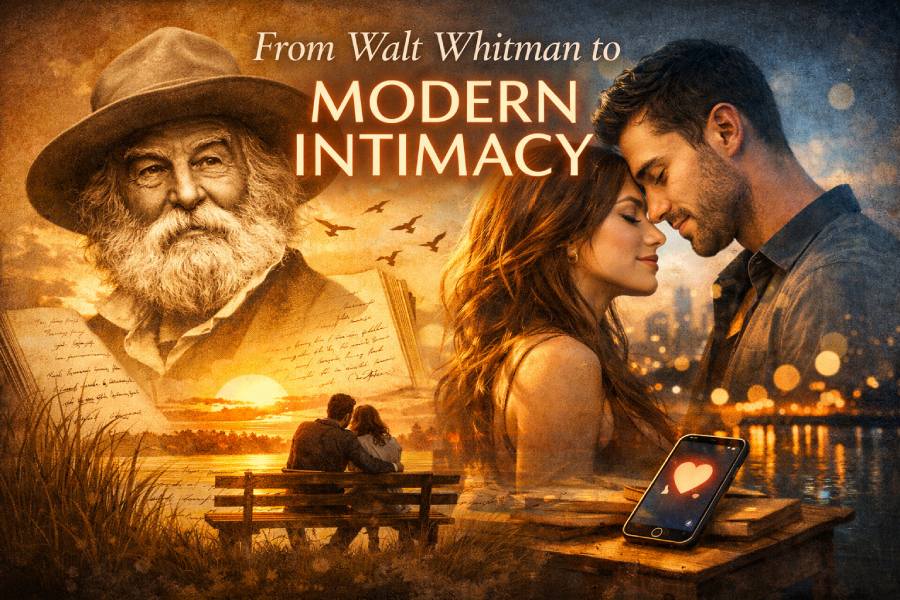
A 19th-Century Poet and a 21st-Century Question
More than a century ago, Walt Whitman challenged the boundaries of how intimacy, the body, and human connection were discussed. In Leaves of Grass, first published in 1855, Whitman wrote openly about physical presence, fleeting encounters, and the deeply personal nature of human closeness — ideas that were radical for his time.
Today, the world looks very different. Technology mediates relationships, connections can begin with a swipe, and intimacy often exists outside traditional definitions. Yet the core human desire remains the same: to be seen, felt, and momentarily understood.
This raises an important question — have our relationships truly changed, or have we simply found new ways to express the same timeless needs?
Walt Whitman and the Freedom of the Body
Whitman’s poetry broke with convention by celebrating the body as something sacred rather than shameful. In Leaves of Grass, physical closeness is not hidden behind metaphor — it is direct, present, and unapologetically human.
He wrote not only about love, but about contact:
- the nearness of another person,
- the shared moment between two individuals,
- the intensity of experiences that may be brief, yet meaningful.
For Whitman, intimacy did not require permanence to be real. A moment could stand on its own.
This perspective feels surprisingly modern.
Fleeting Encounters as Meaningful Experiences
One of the most misunderstood ideas in both Whitman’s work and modern relationships is the belief that short-lived connections lack depth.
Whitman rejected this notion. His poetry suggests that connection does not need labels to be valid, duration does not define emotional significance, and brief encounters can still leave a lasting imprint.
In today’s world, many relationships are shaped by circumstance rather than long-term intention. People meet while traveling, during transitional periods, or simply at moments when companionship matters more than promises.
Rather than seeing these connections as empty, Whitman’s philosophy invites us to view them as honest reflections of human need.
Modern Intimacy in a Digital World
Technology has changed how people meet, but not why they connect.
Modern platforms allow individuals to express desires openly, seek connection without predefined outcomes, and engage with others who share similar expectations.
This mirrors Whitman’s insistence on authenticity. He wrote as himself, without apology, inviting others to do the same.
In contemporary discussions about relationships, intimacy is increasingly understood as something that can exist in many forms — emotional, physical, temporary, or ongoing. What matters is mutual understanding and consent, not conformity to a single narrative.
Why Honest Desire Still Matters
One of Whitman’s greatest contributions was normalizing desire as a natural part of being human. He did not frame longing as something to overcome, but as something to acknowledge.
This idea resonates strongly today. When people are honest about what they seek — whether companionship, closeness, or a moment of shared presence — relationships become clearer and healthier.
Modern conversations around intimacy emphasize transparency, respect for boundaries, and shared expectations.
These values echo Whitman’s belief that truth, even when uncomfortable, is more human than silence.
Timeless Needs, New Expressions
While society continues to evolve, the emotional core of human connection remains unchanged. People still seek closeness without judgment, experiences that feel real, and moments of connection that affirm their existence.
Whitman gave language to these needs long before the digital age. Today, they are simply expressed through different mediums.
Understanding this continuity helps bridge the gap between literature and modern life, reminding us that intimacy is not a modern invention, but a timeless human experience.
The Past Is Still Present
Leaves of Grass endures not because it belongs to the past, but because it speaks to the present. Whitman’s vision of open, honest connection continues to resonate in a world where intimacy is being redefined rather than erased.
Modern relationships may look different on the surface, but beneath that surface lies the same desire Whitman captured so vividly — to connect, even briefly, and to feel alive in that connection.
Exploring intimacy through both literature and contemporary experience allows us to see not how much has changed, but how much has remained the same.

- How to Recognize the Signs of Sexual Tension and Act on Them
- Best Places to Have Sex to Spice up Your Relationship
- Why You Need Seductive Text Messages for Her
- Want to Find Sex Easily? Join Onenightfriend.com to Learn More
- Learn Some Cool Things to Try in the Bedroom
- How to Be a Sugar Baby & What Do Sugar Babies Do?
- But What’s Yours?
- Things You Need to Know on How to Kiss a Girl